
Introduction
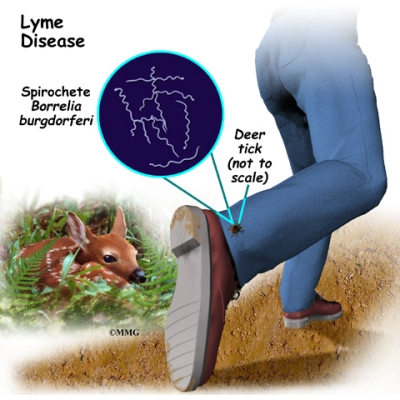
Lyme disease is an inflammatory disease caused by tick bites. It is carried by ticks in North America, Europe, and Asia. More than 90 percent of the Lyme disease cases in the United States happen in New York, New Jersey, Connecticut, Rhode Island, Massachusetts, Pennsylvania, Wisconsin, and Minnesota. It is possible to visit these areas and have the infection show up later, when you are back home.
This guide will help you understand
- how Lyme disease develops
- how doctors diagnose the condition
- what treatments are available
Anatomy
What parts of the body are affected?
Lyme disease can cause inflammation in many systems of the body if left untreated. It mostly affects joints, the heart, and the nervous system.
Causes
Why do I have this problem?
Lyme disease is caused by bites from an infected tick. The human body mounts a reaction to the infecting organism that triggers production of inflammatory agents throughout the body. These inflammatory agents are the chemicals produced by the body's immune system that normally fight off infection.
Symptoms
What does Lyme disease feel like?
Doctors divide the symptoms of Lyme disease into three phases: early localized, early disseminated, and late disease. The three phases of symptoms can overlap. Many patients never show early symptoms at all.
Early localized disease refers to a red rash in the area of the tick bite. This rash shows up within a month of infection. The bite itself is usually found near the waist or belt line, or in other warm, moist areas of the body. The bite may burn, itch, or hurt. The rash usually grows over a period of days. The rash may be in a bulls-eye pattern, red with a white spot in the middle, or completely red.
Most patients with early localized Lyme disease also complain of flu-like symptoms, such as headaches, fatigue, and muscle and joint pain.
Early disseminated disease shows up days to months after the tick bite. Patients may not remember any rashes or bites. The most common symptoms of early disseminated disease are cardiac and nervous system problems. About eight percent of patients who have the rash and are not treated with antibiotics develop heart problems. Heart effects include heart blockage and weakening of the heart muscle. Most of the time, the heart symptoms clear up on their own.
About ten percent of patients who don't receive antibiotics develop damage to the nervous system. Neurologic symptoms also tend to go away on their own, but very slowly. These neurologic symptoms can include meningitis and headaches. Individual nerves can be affected causing numbness, weakness, and pain in the areas the damaged nerve travels.
Late disease symptoms develop months or even years after the tick bite. Some patients who have late disease symptoms have never had any other symptoms of Lyme disease. Late disease causes arthritis pain that comes and goes in many joints. About ten percent of people with late Lyme disease develop chronic (long-lasting) arthritis of one knee.
Many patients who have had Lyme disease describe headaches, fatigue, and joint pain that can last for months after treatment. These problems generally go away without any extra treatment, but very slowly.
Diagnosis
How do doctors identify the condition?
Doctors diagnose Lyme disease based on your health history and a physical exam. Your doctor may order blood tests, but they are only used to confirm the diagnosis. The techniques used to test your blood are called ELISA and Western blot. Both tests can sometimes give false positive or unclear results. If you have had the infection for less than six weeks, your body may not even be making enough antibodies to be detected in the tests.
In very rare cases, the synovial fluid (the lubricating fluid of a joint) or spinal fluid may need to be analyzed to confirm Lyme disease.
Treatment Options
What can be done for Lyme disease?
Two to four weeks of antibiotics almost always cures Lyme disease. Early treatment usually prevents later heart, nerve, and joint symptoms. If you have symptoms of early disseminated or late disease, your doctor will probably start you on intravenous (IV) antibiotics.
Headaches, fatigue, and muscle and joint pain may continue for months after finishing the antibiotics. Neurologic damage may take even longer to go away, as the nervous system regenerates only one or two millimeters each day. This does not mean that you need more antibiotics. Your body just needs more time to heal. If the antibiotics do not help your symptoms at all, you and your doctor should consider that Lyme disease may not be the cause of your symptoms and look for other possible causes.
The risk of getting Lyme disease is very small, even if a tick has bitten you. Doctors do not treat you just in case. You must show symptoms.
The best treatment for Lyme disease is prevention. Check for ticks at the end of a day outdoors. Wear light clothes so you can see ticks. Wear long clothing, and tuck your pants into your socks. And finally, use a bug spray that contains DEET (a chemical used in some types of insect repellents) to keep the ticks away.
 |
All content provided by eORTHOPOD® is a registered trademark of Medical Multimedia Group, L.L.C.. Content is the sole property of Medical Multimedia Group, LLC and used herein by permission. |
